
But what about that 'upgrade'? To turn 'low value' businesses into 'high class establishments'? What have they achieved in that area? Dennis Boutkan from the PvdA, the political party who started this whole project under the wings of former alderman Lodewijk Asscher and later under mayor Eberhard van der Laan, even wrote an article in the newspaper claiming the Red Light District is improving.
So let's see what great improvement there has been in the area, and let's take a look at all the former brothels that were closed down, and see how they are today. The question is, is it an upgrade that achieved turning prostitution, something considered to be a 'low value business', into a high class establishment. Judge for yourself. Here are some pictures from some of the streets before the closures.
Amsterdam's Red Light District before closures
 |
| Boomsteeg before |
 |
| Trompettersteeg 5 before |
 |
| Dollebegijnensteeg 5 before |
 |
| Goldbergersteeg (Sint Annendwarsstraat 26) before |
 |
| Oudekerksplein 2 and 4 before |
 |
| Betlehemsteeg (Sint Annendwarstraat 24) before |
Amsterdam's Red Light District today
Oudezijds Achterburgwal areaMain Red Light District canal including connected alleys
Before: Brothel with 4 prostitution windows. One of the 18 buildings that were bought for 25 million euro from Charles Geerts, about 500.000 euro per window, making this building cost about 2 million euro.
After: These buildings haven't been in use for years. The buildings have been neglected. In fact, nothing much seemed to have been changed since 2007 when they bought these buildings. In one place there's upstairs even a red light still burning. Why was this worth 2 million euro you'll be asking yourself? Good question! The building is currently being considered to re-open again as a window brothel under Project Own Window, if they ever get that project of the ground. And if the project doesn't work out, the mayor has already stated it will not be available for prostitution anymore. As you can see, no upgrade or high class establishment here.


Boomsteeg 2
Before: Brothel with 4 prostitution window. Another one of the former buildings from Charles Geerts, meaning also this building was a 2 million euro investment of tax payers money from the city government.After: Like the previous building, also this building hasn't been in use for years. It's been neglected, just like the other building, and also this building is being opted for a possible re-opening of window brothels under Project Own Window. Again, no upgrade or high class establishment, just more neglect.


Oudezijds Achterburgwal 17
Before: Brothel with 1 prostitution window. Also this building was owned by Charles Geerts, meaning the costs of this building comes down to about 500.000 euro.
After: Also this building is not in use. And since it's not being used anyway, the prostitution health organisation funded by the city, P&G292, has took the opportunity to display their recently released magazine 'The Sex Worker' behind one of these windows. Nobody ever uses this building however, it's just another empty building. Again, no upgrade or high class establishment.


Oudezijds Achterburgwal 19
Before: Brothel with 4 prostitution windows. Also this building was owned by Charles Geerts, meaning the costs of this building were around 2 million euro.
After: Like the other buildings, also this building is not being used. Neglected as you can see, it's just another building people pass in the Red Light District without ever looking at. Great upgrade again people! And, oh yes, also this building might re-open perhaps one day again as part of Project Own Window. Again no upgrade or high class establishment.


Oudezijds Achterburgwal 27
Before: Brothel with 4 prostitution windows. Another building from Charles Geers, and another 2 million euro for the tax payers.
After: Yep, you got it! It's empty again! Not in use anymore after a previous business, Ignoor, left the building years ago to open up in the Magnoliastraat outside of the Red Light District. Another empty building, another great improvement! So again, no upgrade or high class establishment.


Oudezijds Achterburgwal 60 and 62
Before: On nr. 60 Brothel with 4 prostitution windows. Also this building belonged to Charles Geerts, meaning this building has a price tag of 2 million euro. And on nr. 62 the old office of Charles Geerts himself.
After: Yes, it still looks like a brothel including red lights and red curtains, and that's because today it's a prostitution museum partially funded by the city itself, including misleading information about how many women are forced in this area. And perhaps this is also the reason this brothel look-a-like is allowed, while real brothels aren't, because it shows what the city wants you to see, their version of prostitution. Funny enough, it's the most successful 'upgrade' this project has achieved. Turning a brothel into a museum looking like a brothel about prostitution. But is turning a brothel into a museum posing as a brothel an upgrade? You might say visually no, because it looks exactly like a brothel, but the fact that it has become something of a museum you might say yes. So we'll count this as an 'upgrade'.


Oudezijds Achterburgwal 64
Before: Brothel with 3 prostitution windows. Also this building was owner by Charles Geerts, meaning also this building cost tax payers 1,5 million euro.
After: A cheese and wafel shop. Ironically the same people that complained about the Red Light District before and were happy that they closed down window brothels are now the same people that complain about the huge amount of cheese, wafel and ice cream shops (the center of Amsterdam has 90 of them!). So it's ironical that the one thing it got replaced with is again something many people complain about. And since we already have 90 of these kind of shops in the city's center, I'm not sure if another cheese and wafel shop would be considered an 'upgrade', since already people are talking about doing the same thing with cheese, ice cream and wafel shops, as what they did with brothels. People want them gone. But I'm pretty sure a shop like this isn't a 'high class establishment'.


Oudezijds Achterburgwal 66
Before: Brothel with 3 prostitution windows. Another building formerly owned by Charles Geerts. Costs? About 1,5 million euro for the tax payers.
After: Rarely in use as an exposition space. Most of the times it's closed, just like how you see it in the picture. Occasionally it's being used as a studio space and exposition room. Last time it had an exposition was 11-09-2015, and before that 12-12-2014, just to give you an idea of how popular this place is. I doubt with such low interest they are able to pay the full rent, so this is probably one of those businesses that get a huge discount on their rent just to occupy the place as place holders.


Oudezijds Achterburgwal 80
Before: Brothel with 3 prostitution windows. Another one of Charles Geerts his buildings, which puts the price around 1,5 million euro.
After: The building is being used by two businesses. The first one is Off The Wall, a concept store which is currently closed apparently because it was completely dark inside. Looking on the Facebook page of this concept store, you can see it's a 'cultural gift store' selling hugely popular stuff like cufflinks for 25 euro, t-shirts for 15 euro and apparently also art for an unknown price. Also this shop doesn't pay the full price for their rent, but get a discount to serve as a place holder,
The second shop above is Kuro, which is a jewelry shop, but apparently they are also looking for a barber, which just shows you the weird combination. It's not selling expensive jewelry however, like as in diamonds and gems, but more hippy and urban like jewelry out of leather and stuff like that. Strongly getting the idea this is another one of the concept stores that doesn't pay full rent, but serve as placeholders and get a big fat discount from the city to keep us out.


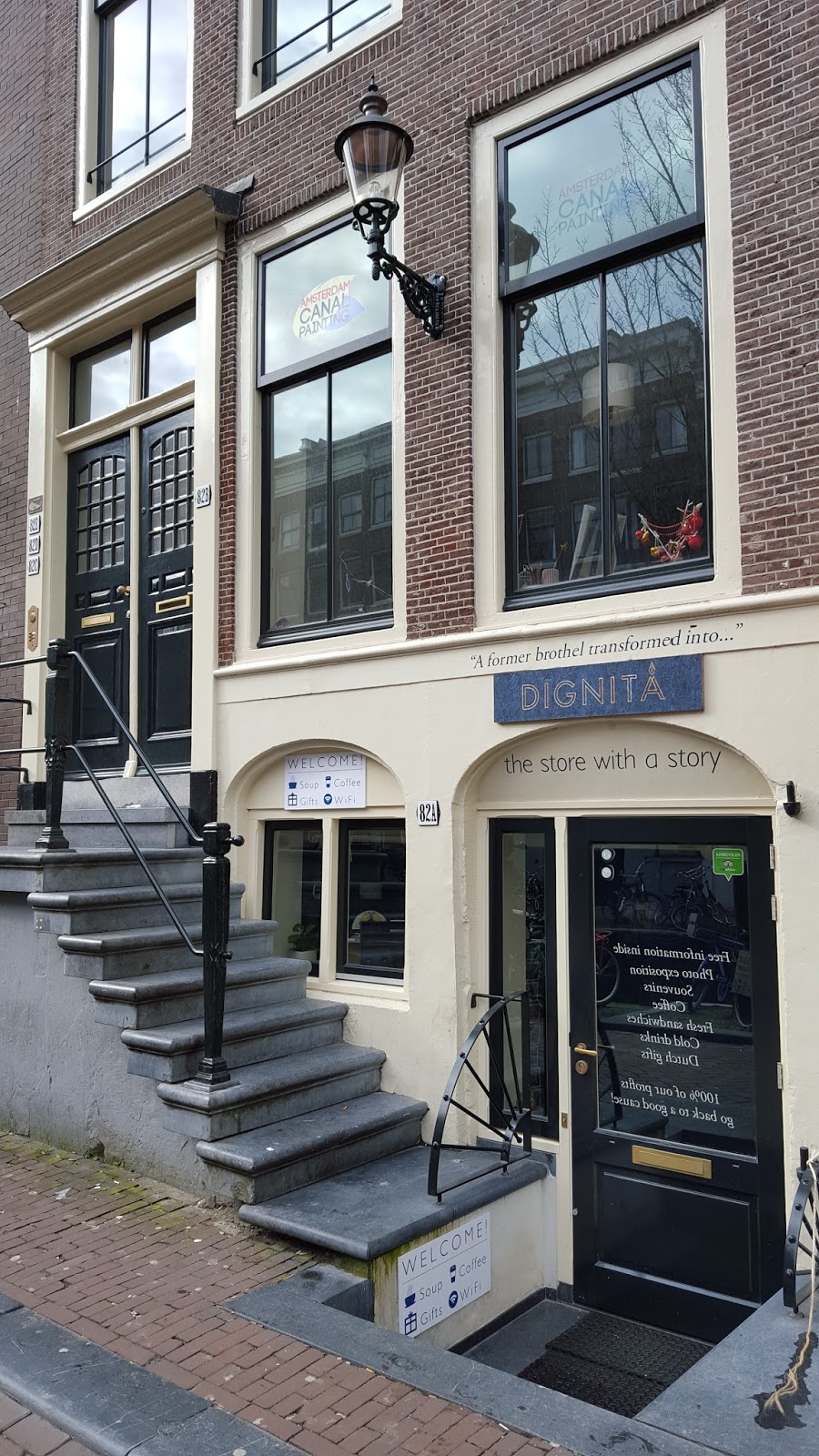
Oudezijds Achterburgwal 82
Before: Brothel with 3 prostitution windows. Also this building was owned by Charles Geerts, putting the costs again around 1,5 million euro.
After: Now it's a shop owned by NGO 'Not For Sale' called Dignita, which fights human trafficking while selling things at the same time. Don't let the pictures on their website fool you, those are the pictures of their restaurant elsewhere in Amsterdam, the shop itself is far less appealing and low budget looking. The shop advertises with the fact that this used to be a former brothel, and in a commercial for the christian political party ChristenUnie (most famous for their anti-prostitution statements) the owner even claims that 'forced women used to work here', even though there's no proof for that claim. The shop was closed however at 2 pm in the afternoon on the Friday we took this picture, and the times it was open few people go inside.

Barndesteeg 5
Before: Brothel with 3 prostitution windows. Another one of the former buildings of Charles Geerts if I'm not mistaking, costing about 1,5 million euro's again.
After: Previously here was 'Red Light Fasion', a temporary project by the city to show what the Red Light District 'could be'. After that it was empty for years until recently a tattoo shop opened up here. Although when we took this picture at 2 pm the shop was closed, as well as the next day. Often it seems to be empty inside, with no people coming in. The fact that their website is still under construction suggests it's a start up company, and also the inside of the shop looks like it doesn't have a large budget. It's probably another example of a placeholder, not paying the full price for their rent. But was a tattoo shop really the upgrade they were looking for? And how can you count a tattoo shop as a 'high class establishment'?


Oudezijds Voorburgwal 97
Before: Brothel with 2 prostitution windows. Another one of Charles Geerts' buildings if I'm not mistaking, which puts the price tag around 1 million euro.
After: Art gallery/shop that's been here for a while already. Not too many people go in here. One interesting detail however is the painting hanging in the top window, of a nude woman. So I guess there's still a woman standing behind a window there, even though it isn't a brothel. Is that trying to profit from the area's fame as a prostitution area or just coincidence? Anyway, not sure if this shop is making a lot of money or not to be able to pay for the rent of a building worth 1 million euro, so I think also this shop gets a large discount to be a placeholder.


Gelderse kade
Situated a little bit outside of the main Red Light District area
Geldersekade 42
Before: Brothel with 3 prostitution windows. Another one of the buildings previously owned by Charles Geerts, putting the costs around 1,5 million euro.
After: Looks like someone's private residence, although I'm not sure. Not sure if we can count a simple private residence as a 'high class establishment' though, but perhaps an upgrade. At least it's better than another cheese shop, right?


Geldersekade 76
Before: Brothel with 4 prostitution windows. Another one of Charles Geerts his buildings, putting the costs around 2 million euro.
After: A laser hair removal salon. It was closed however at 2 pm in the afternoon. It still looked to be in use though. The salon is part of a larger company with several shops all over the country. But can we call a laser hair removal salon a high class establishment? Well, I'll count it as a possible upgrade.


Sint Annenkwartier
Prostitution filled quarter of small alleys part of the main Red Light District
Dollebegijnensteeg 5
Before: Brothel with 3 prostitution windows. Previously owned by Office 52, which traded these buildings for window brothels in Stoofsteeg that were previously owned by Charles Geerts. Which puts these buildings also roughly around 1,5 million euro.
After: Yep, it's empty again. The previous business that was in here, Peer, has moved just outside of the Red Light District area. The owner was already complaining before in newspapers that few clients came inside. Not such a weird thing in such a small alley, especially if it's being mainly dominated by prostitution. But even without prostitution I doubt people would ever go into such a small alley to see what is there, if it's not something hugely interesting. Right now the place just looks like a construction work place. Guess the upgrade didn't work here, and it certainly doesn't look very 'high class' at the moment.

Dollebegijnensteeg 3
Before: Brothel with 3 prostitution windows. Like the previous one these buildings were owned by Office 52 and traded them for some windows elsewhere that were owned by Charles Geerts. This puts the value yet again around 1,5 million euro.
After: It looks unused. In most of the windows it seems empty, looking through one window you can see a video projection on the wall, but it doesn't look like anyone's using it. It's certainly not a shop or anything. Was this really worth 1,5 million euro's? To have it being unused, like many other buildings? So is this the upgrade? I doubt it, since the buildings aren't being used much if at all. Is it a high class establishment? Well, if you call being empty and forgotten high class.


Sint Annendwarsstraat 26 (Goldbergersteeg)
Before: Brothel with 8 prostitution windows. 2 Windows in front, and 6 windows down the stairs in what is called Goldbergersteeg, an alley. Not sure how much these windows were paid for, but since they're usually worth depending on how many windows there are, this is probably a pretty expensive building around 2,5-4 million euro, rumors even say much more.
After: It's been empty and unaltered ever since the brothel had to close down. I knew all the women that worked here, I've only seen a few of them now working elsewhere in the Red Light District, their income has declined however since this was one of the most popular places for clients to visit. No upgrade to see here, since the gate is also closed and the buildings is not in use.


Sint Annendwarsstraat 3 (Trompettersteeg)
Before: Brothel with 5 prostitution windows. 2 Windows facing the Sint Annendwarsstraat and 3 windows going into the Trompettersteeg alley around the corner. Also this building belonged to Office 52, and they swapped these windows for some other windows elsewhere in the Red Light District that were previously owned by Charles Geerts. This means this building is worth around 2,5 million euro.
After: Hangover Information Center. Speaking from watching it every day, not a lot of people go inside. During the day it's mostly closed, like here in the picture we took at 2 pm in the afternoon. During the night sometimes people come in to watch. Most people think it's funny, but don't actually buy anything there. There's also not much to buy, it's just one drink that apparently will magically cure your hangover. Seeing how few people actually buy from here, I cannot imagine this shop making enough money to pay for their rent. Another placeholder perhaps? Everything about it looks very sterile. During the nights the white lights from this thing are blinding and screw up the whole atmosphere the red lights are giving off. But I'm guessing that's also it's purpose, to disturb the old atmosphere and scare off our clients. And perhaps you could see this as an upgrade, although it completely doesn't fit in this area, but I doubt you can call it a 'high class establishment'.


Before: Brothel with 3 prostitution windows. From the same owner as the building of Sint Annendwarsstraat 26. Unknown how much was paid for, but probably around 1,5 million euro, rumors even put it around 4,5 million euro.
After: As you can see another huge upgrade. A by garbage bags covered building. Nobody seems to own or use it. Not really high class.


Sint Annendwarsstraat 24 (Betlehemsteeg)
Former function: Brothel with 6 prostitution windows. The owner of the buildings sold it, so the brothel owner had to move against his will. Not sure how much was paid for, but perhaps somewhere around 3 million euro, considering the amount of windows.
After: A lunchroom. Actually one of the few things that look good, though it's completely out of place at the moment in the midst of this prostitution only area. Not very busy inside though. But is this a 'high class establishment'? A lunchroom? Besides, why do we need a lunchroom here, while on the corner there's also a lunchroom many people already go to, including all the prostitutes that work in this area?


Trompettersteeg 3
Before: Brothel with 2 prostitution windows, part of the same building on the other side in the Dollebegijnensteeg.
After: Before there used to be 2 windows on this side, and 3 windows on the other side in Dollebegijnensteeg as part of this building. Now they broke out all the walls it's just the same place as Dollebegijnensteeg 3, meaning it's not in use, again! No upgrade or high class establishment.


Trompettersteeg 5
Before: Brothel with 2 prostitution windows, same building as Dollebegijnensteeg 5 on the other side.
After: Like the other windows above, also these 2 windows have been turned into one big space by breaking out the walls, and is now one place that on the other side is Dollebegijnensteeg 5. This is where Peer used to be, which has now moved on elsewhere like I explained before. No upgrade and certainly not high class!


Old Church Square
Part of the main Red Light District area well known for being situated around the Old Church
Oudekerksplein 4
Before: Brothel with 4 prostitution windows. Not sure who owned this before, or what the price was, but probably somewhere around 1,5-2 million euro's based on what others got paid for.
After: A lunchroom/terrace. At times it can be busy here, one of the few places which is kind of successful, although it was both empty outside and inside when we came there at 2 pm in the afternoon. Around the corner is a bar/terrace which is always filled with people, which makes you wonder why this terrace wasn't filled when we took the picture? So this could be considered an upgrade, but a lunchroom as a high class establishment is up for debate I guess.

Oudekerksplein 22
Before: Brothel with 2 prostitution windows. Unknown what was paid for, but probably somewhere around 1 million euro.
After: Red Light Radio. It's a well known story that this place has been given to the people that run this radio station. They pay minimum rent. I doubt however they can call this a 'high class establishment', since the look has remained exactly the same from when it was a brothel, and since the people in this building are hardly paying rent, I doubt this will be like this forever. Probably still waiting for investors to come along. Inside it's cluttered, messy and further nothing has changed since it was a brothel, except the fact that now you can see a couple of guys playing a radio station behind the windows, in stead of some women. Just another placeholder, no upgrade.

Oudekerksplein 26
Before: Brothel with 6 prostitution windows in a small court yard. Completely unknown how much was paid for this, or who the owner was, so guessing how much they paid for it is difficult, but could range around 2-3 million euro.
After: Right now it's nothing. The gate towards the court yard is closed, and nobody ever goes in. What once was a place for women to work in, has now become a forgotten piece of Amsterdam. No visitors, no workplaces, simply nothing. Is this what was worth over a million euro? To have nobody use it at all? Is this an upgrade? I don't think so, and it certainly isn't a 'high class establishment'.


Oudekerksplein 30
Before: Brothel with 3 prostitution windows. Unknown who owned it or what was paid for it. But based on the other prices probably around 1,5 million euro.
After: Some kind of shop. It's located next to the PIC where I frequently come, but I still don't know what they do in here. Often it's closed, like now when we took this picture at 2 pm in the afternoon. And sometimes it's open, although few people go in there, I can tell from standing next to it for hours already. I doubt this shop is making enough money to survive on it's on. I think like many of the other buildings, the people running this shop aren't paying the full rent, and are just placeholders until real investors show up one day. So I'm not sure if you can call it an upgrade, and inside it's too empty looking for me to call it a 'high class establishment', but I'll leave that up to you to decide.

Slaperssteeg
Before: Brothel with unknown amount of prostitution windows in this small alley. Unknown how much was paid for it.
After: This alley which used to have a couple of windows is now completely forgotten. I didn't even knew anything was here until we started to research it. The closed gate makes sure nobody ever comes here. A forgotten piece of Amsterdam what once used to be women's workplace. Not an improvement, but a downgrade as you can see. And certainly not very high class.


All pictures were taken on a regular Friday afternoon at 2 pm, a normal time for any shop to be open, and for people to visit the area, especially in the center of Amsterdam. Like always the streets with prostitution were filled with people, averaging from 10-25 people per street, the areas with little to no prostitution were much more quiet with often hardly any people at all. Where prostitution draws in many people, men but also many women interestingly enough, the new businesses that are supposed to 'upgrade' the Red Light District were often empty or even closed at 2 pm in the afternoon!


